Double Oven Experiences
Thoughts on using a double oven range
Late last fall we “suddenly” found ourselves in need of a new kitchen range. While doing research on what to buy, I discovered that several appliance manufacturers made ranges that did away with the common storage drawer under the range and used that space to squeeze two ovens under the cooktop. With the way we actually use our range, this seemed like it might be a good fit for us, but then I started to lose my mind trying to figure out if seeming like was close enough to being. Then I lost what was left of it while trying to find something to, y'know, buy, especially in time to cook Christmas dinner. But we managed it.
Background
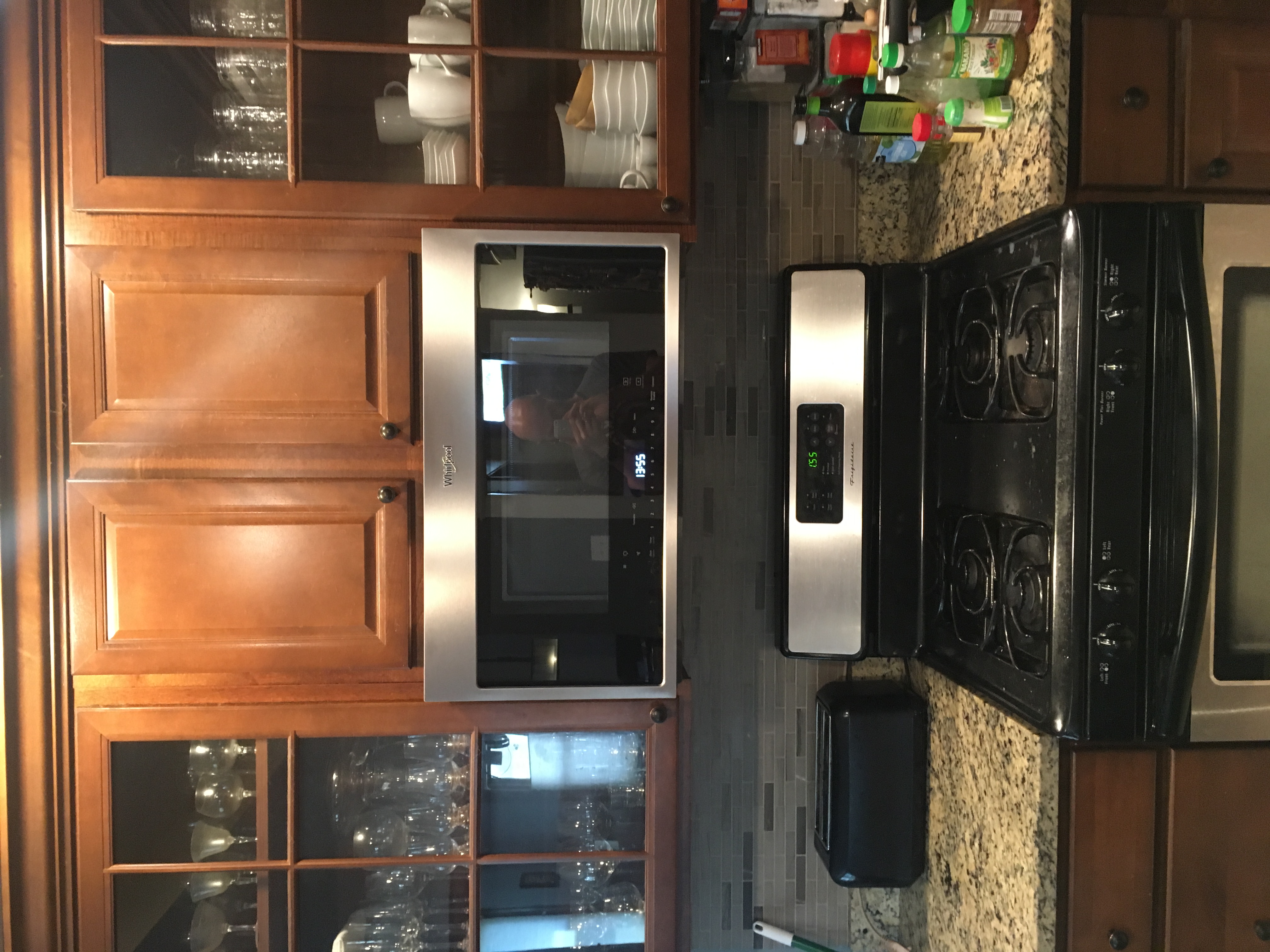 A photo I took after installing the microwave that replaced the one that came with the house. Spoiler alert: this microwave suffered a premature death.
When we bought our house most of the appliances dated from a flip that was completed in 2009, and the kitchen appliances were all builder grade at best. The dishwasher was the first to fail on us, but the range held out for a long time. It was just a basic model, but the oven temperature was accurate and we could work around the hot spots on the cooktop, so there was never a good enough reason to upgrade it. Last year, however, we noticed that one of the two front burners seemed like it wasn't getting as hot as it used to, and in November the problem finally got so bad that we couldn't work around it (the design of the cooktop meant that we couldn't fit large pots on the back burners, so any cooking that required two pots on high heat at the same time required a lot of shuffling). I looked into getting parts, but the prospect of a gas leak meant that I wasn't particularly comfortable trying that repair on my own, and my wife was completely stressed out by the idea of me working on it. We realized that by the time we paid for parts and a service call, we'd maybe be throwing good money after bad.
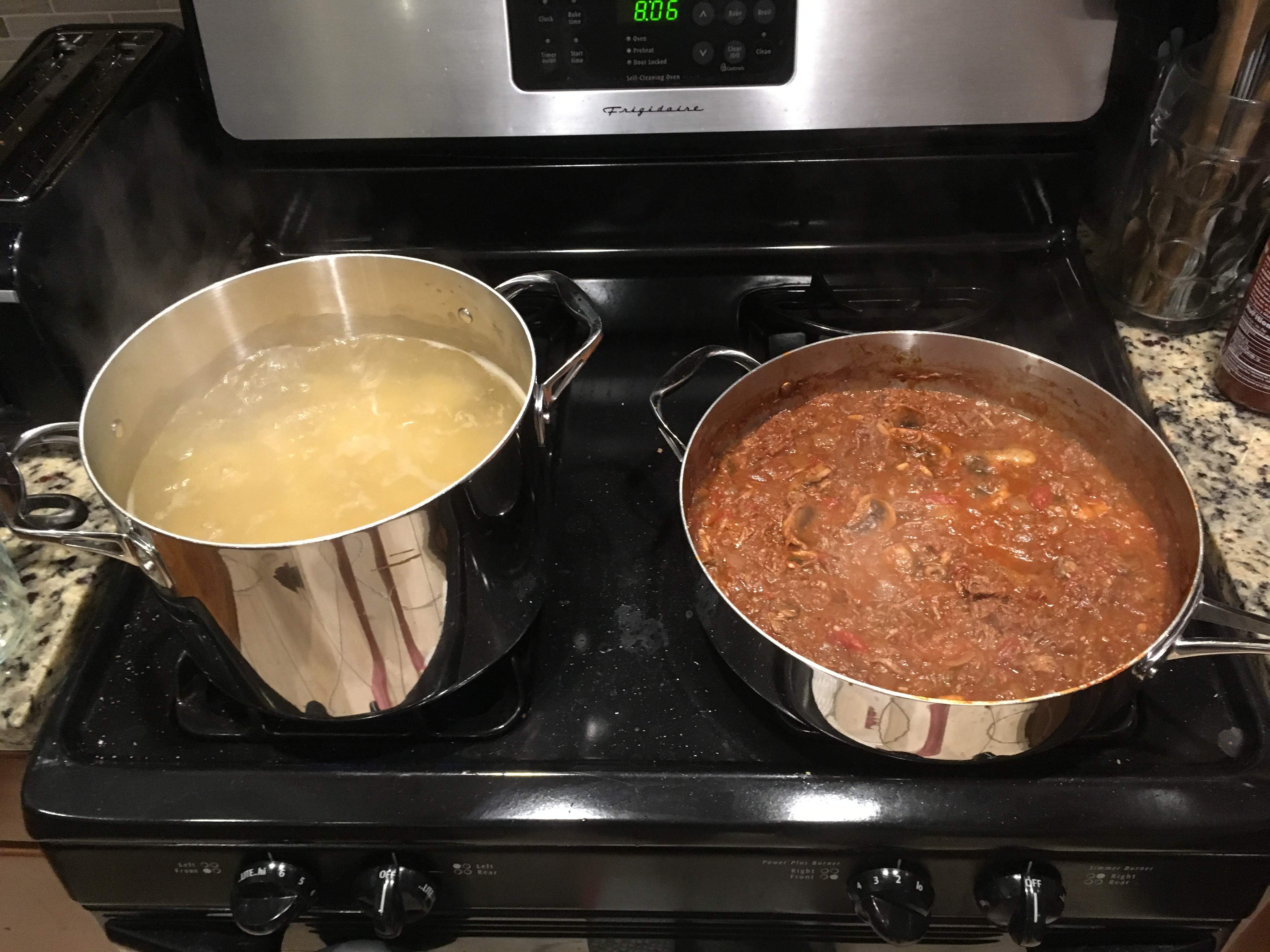 This isn't the worst of it, but it does show how crowded the old cooktop looked with only two pots on the front burners. There's not a lot of room behind them.
I spent a fair amount of time just trying to figure out what would be worth buying. While we would have liked to switch to induction, our kitchen doesn't have the 240V circuit needed for an electric range and we couldn't afford the dual upgrade all at once. Given the constraint of gas, our choices were to replace the basic range we had with another basic one, or to spend a bit more money for a nicer gas range. The more I looked, though, the more a double oven range seemed like it would work well for us. Meanwhile, we noticed that newer ranges often came with either a fifth burner (in the middle) or even six burners in two rows of three, with an optional cast iron griddle you could mount in the middle. That also seemed like a good idea, but by the time we found a model that had the burner arrangement we liked and a double oven, we'd be over budget even without a switch to induction. I ended up with a spreadsheet with model numbers, burner configurations, Consumer Reports rankings, and pros and cons for every possible model culled from as many reviews as I could find.
So then I spent a maddening several weeks trolling Craigslist, eBay, and so on for lightly used models that filled the right boxes in our spreadsheet. Our timing was terrible, though, since the end of federal subsidies for solar installations and electric conversions meant there were no longer as many used models for sale as there had been even just a few months before. I made several drives into the suburbs only to find that the listed model numbers were wrong, or parts were missing, or both. One day I even hopped on my bike to cross town to a house that was being flipped, only to discover that the range on offer was dual fuel (and not just gas) and required 240V for the ovens. Sigh.
I was at the point of giving up when a Craigslist seller posted a deeply discounted “new” double oven range. I called, and the guy read the right model number over the phone, so I made one more trip to the deepest suburbs (this time, an industrial park near Springfield Mall). The range was pretty badly dented on the sides, but the front and top looked OK, all the parts were there, and it was 60% off retail. The guy said he'd gotten five of the exact same model in one lot, and he'd marked this last one down just to get rid of it. He (correctly) said I'd be able to register it for the full warranty, so I gave him a credit card and paid for delivery while I was at it.
Just to make this saga even longer: I'd planned to install the new range myself, and I had removed the old range in preparation, but then it turned out that the fitting on the gas supply line (which is brass and has to be replaced when you replace the flex line that connects to it) hadn't been treated with the right pipe sealant and had fused to the supply line. So then I had to pay for a plumber, because again, I didn't feel comfortable touching a gas line.
The actual review
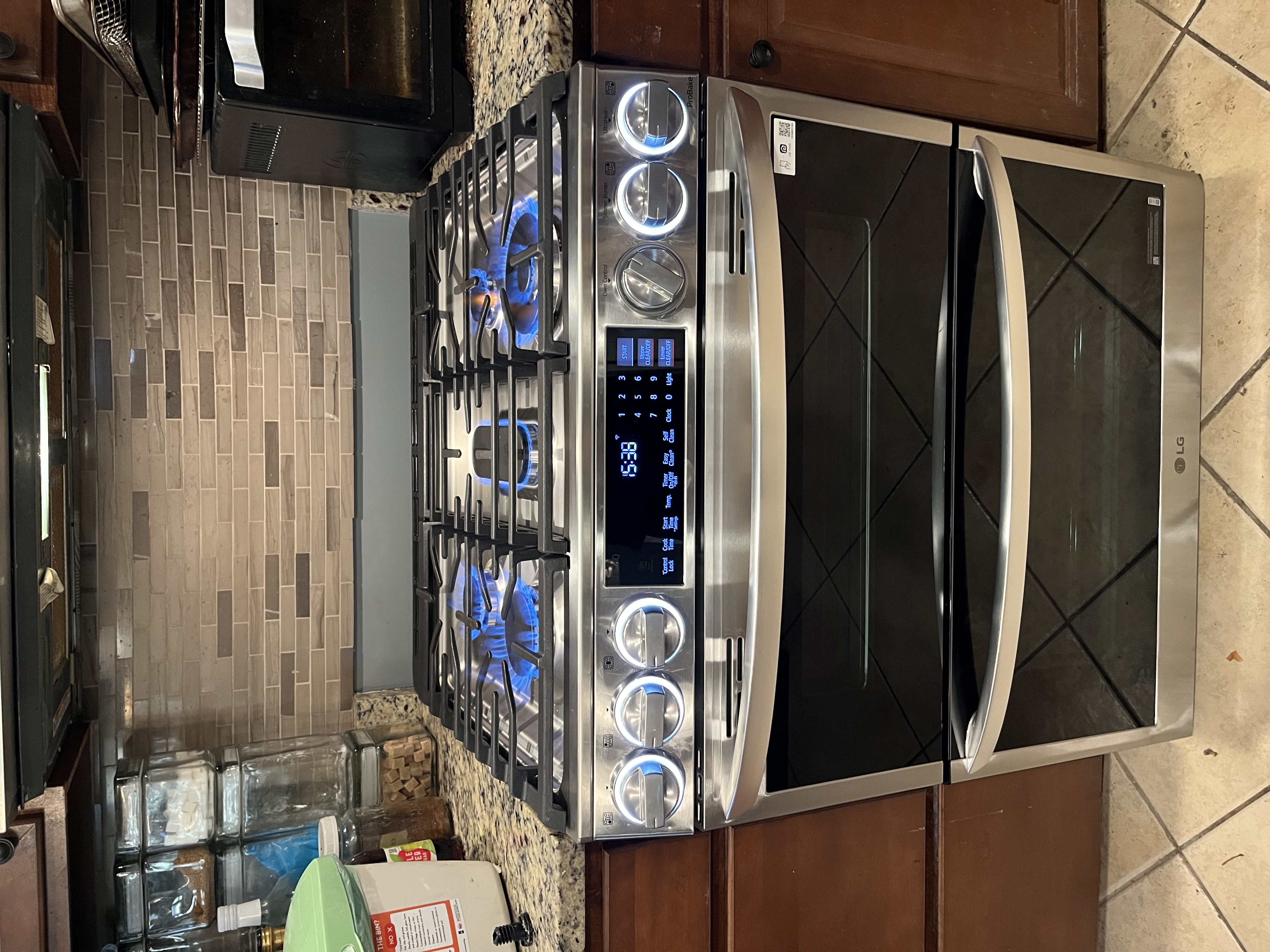 Behold, our shiny new range just after installation. Yes, the gap in the tile backsplash behind it is annoying, but we deal with these problems as we can.
Despite my best efforts to buy a GE/Profile/Café, we ended up with an LG LTGL6937F, because it was what we could buy for the price we wanted to pay. LG doesn't have a great reputation for post-sales support and service in the US, and reviews for this model on the LG web site often mentioned that things in the upper oven tended to burn, so I wanted to avoid those problems, but the price was certainly right, and I figured I'm patient enough to adapt. Here's what I've learned since we installed the new range last year:
The upper oven does, indeed, have a tendency to burn things if they're not carefully managed. There are two rack positions, but the top position is basically only useful for broiling, and the bottom position is very close to the heating element.
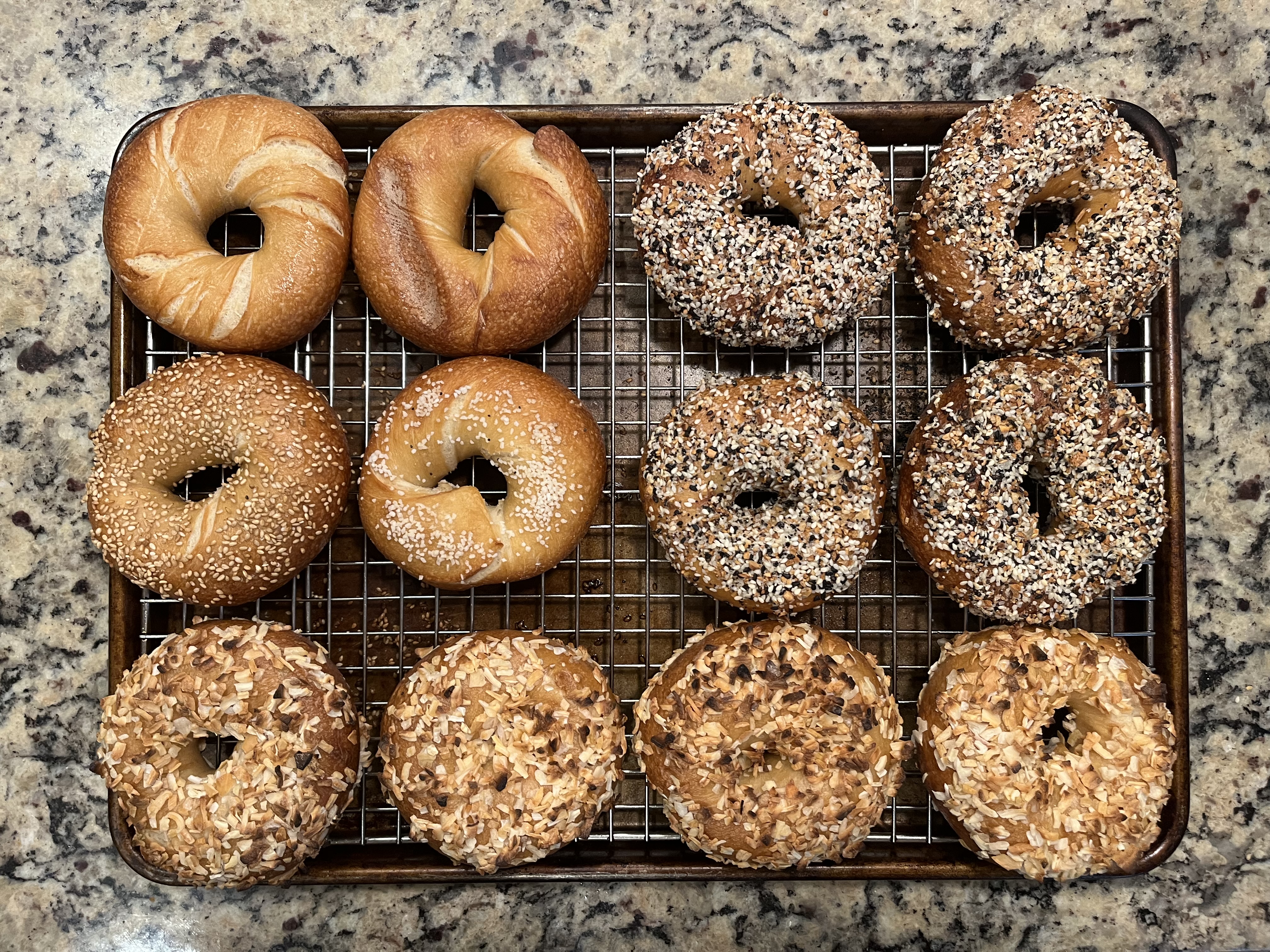 I tried baking these with the rack set to the upper position. The bagels directly under the broiler element ended up with scorch marks, such as the one second from left on the top row.
Despite the fact that the temperature reading does seem to be accurate (to the best of my ability to measure it with probes), the more direct heat is noticeable. It's also hotter towards the back, and hotter still at the back left corner. This is most problematic when making cookies: if you don't rotate the pan soon enough, you'll end up with two or three burned cookies in one corner of the pan, but you also may find that there's more browning than desired on the bottoms of every cookie. I recently made pizza (using a stone) and the crust was particularly dark along the edges where I know the upper oven to be hottest.
I tried baking these with the rack set to the upper position. The bagels directly under the broiler element ended up with scorch marks, such as the one second from left on the top row.
Despite the fact that the temperature reading does seem to be accurate (to the best of my ability to measure it with probes), the more direct heat is noticeable. It's also hotter towards the back, and hotter still at the back left corner. This is most problematic when making cookies: if you don't rotate the pan soon enough, you'll end up with two or three burned cookies in one corner of the pan, but you also may find that there's more browning than desired on the bottoms of every cookie. I recently made pizza (using a stone) and the crust was particularly dark along the edges where I know the upper oven to be hottest.The lower oven relies on a circulating fan for even heat distribution. It can operate in convection mode (with the fan on continuously), but even when it's operating in standard mode the fan will cycle on and off. As a result, I've found that items that are uncovered bake slightly more intensely than they did at the same temperature in our old oven. This is most notable with bread.
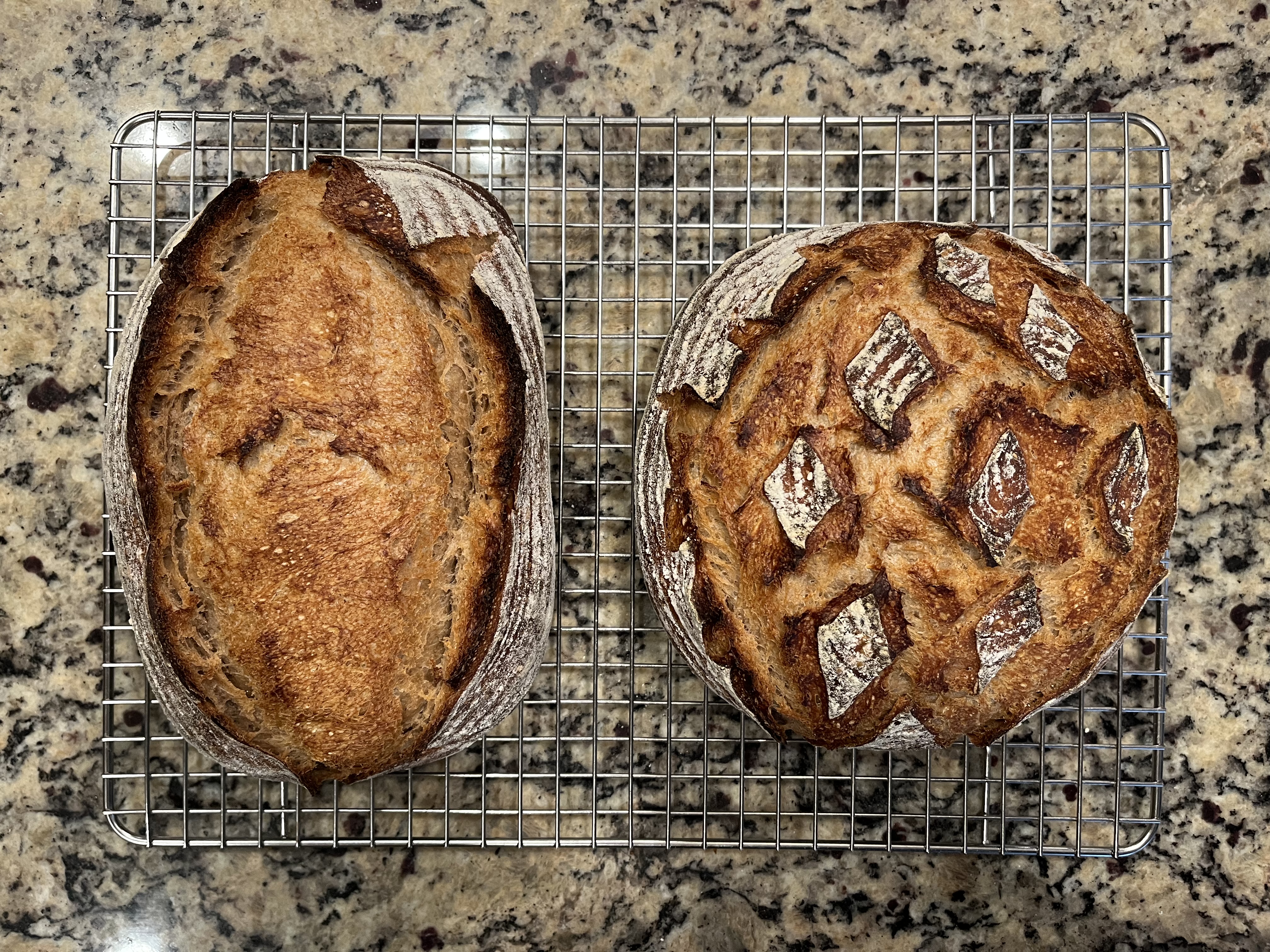 BEFORE: These were the last couple loaves I baked in the old oven, for reference with the next few photos.
The first few loaves I baked in the new oven came out a much darker brown than expected, and I had to adjust the temperature of the oven to maintain the same timing for a bake.
BEFORE: These were the last couple loaves I baked in the old oven, for reference with the next few photos.
The first few loaves I baked in the new oven came out a much darker brown than expected, and I had to adjust the temperature of the oven to maintain the same timing for a bake. 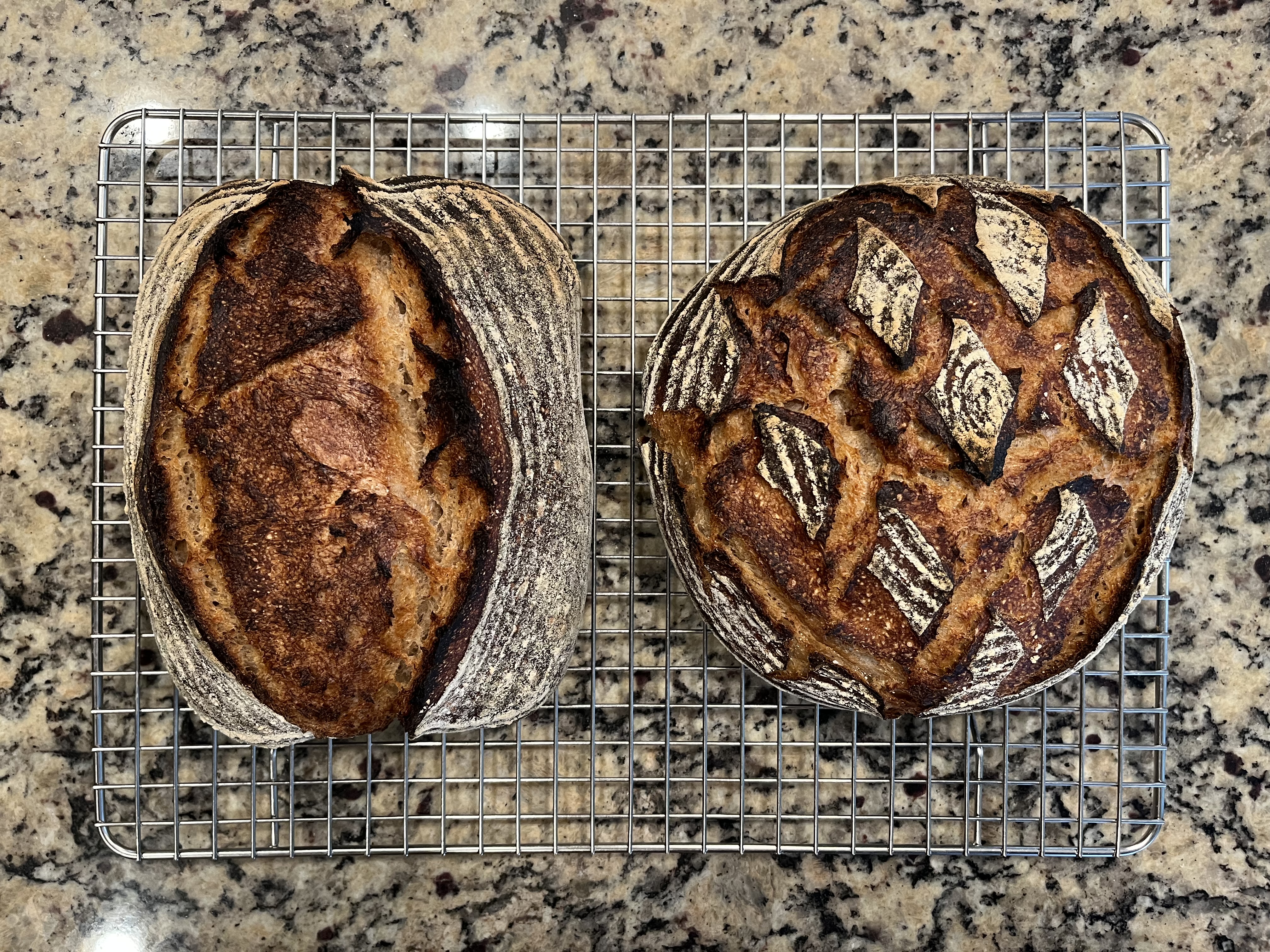 AFTER: These were the first loaves I baked in the new oven. They're not burnt by any means, but they're darker than desired.
But since the fan cycles on and off as needed, the adjustment is not the full 25° F typical with convection. For example, for baking bread and bagels I've settled on 435° F instead of 450° F.
AFTER: These were the first loaves I baked in the new oven. They're not burnt by any means, but they're darker than desired.
But since the fan cycles on and off as needed, the adjustment is not the full 25° F typical with convection. For example, for baking bread and bagels I've settled on 435° F instead of 450° F. 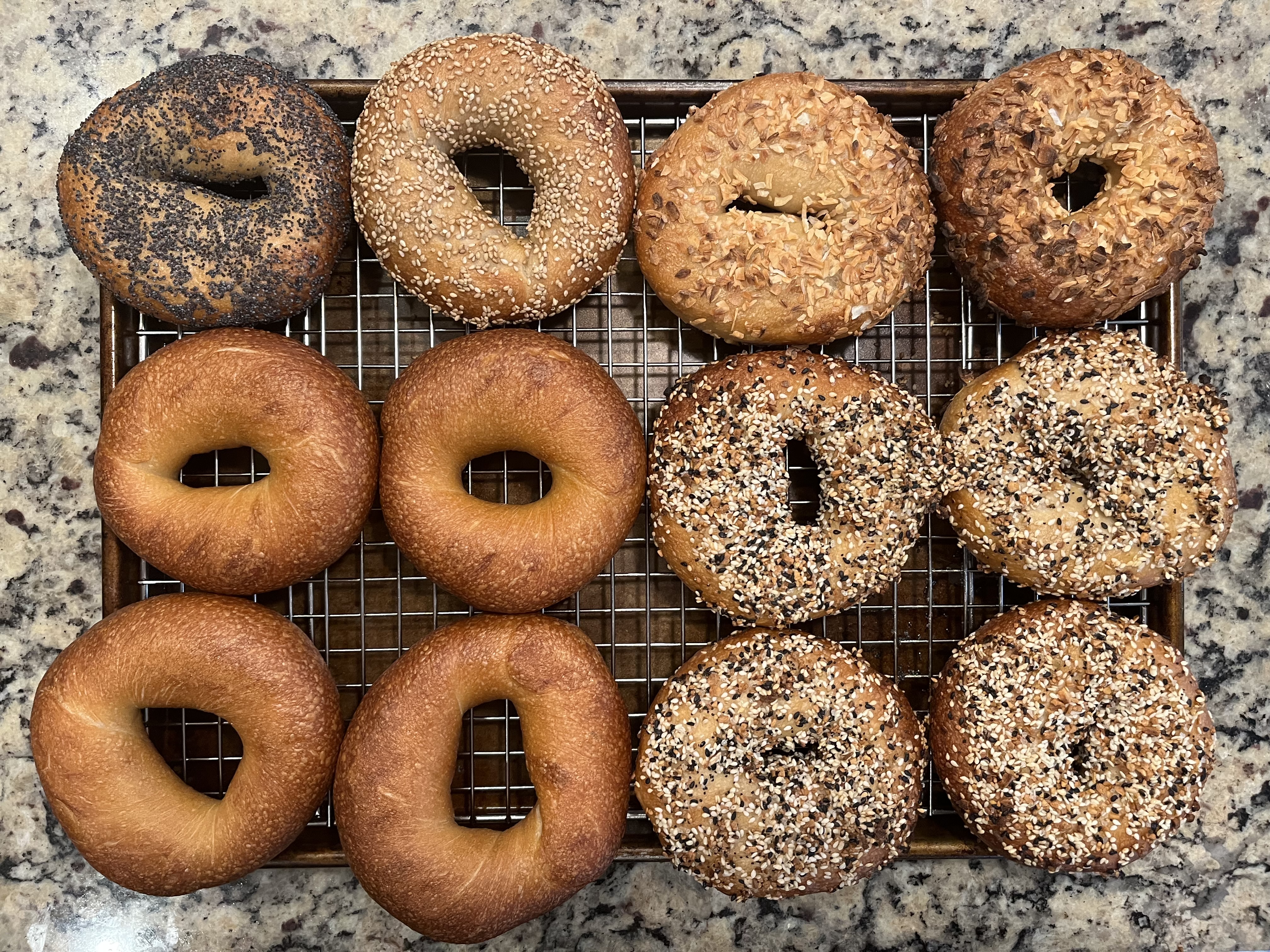 These were started on a stone, in the lower rack position of the upper oven, and then finished in the lower oven at 450° F. Like the sourdough, they seemed to be baking as if they were in a hotter oven, and the first ones out of the oven were too dark.
Because of the placement of the heating element and circulating fan, any baked goods will brown more towards the back of the oven if they are not rotated partway through baking. They don't burn like they might in the upper oven, but the difference is noticeable.
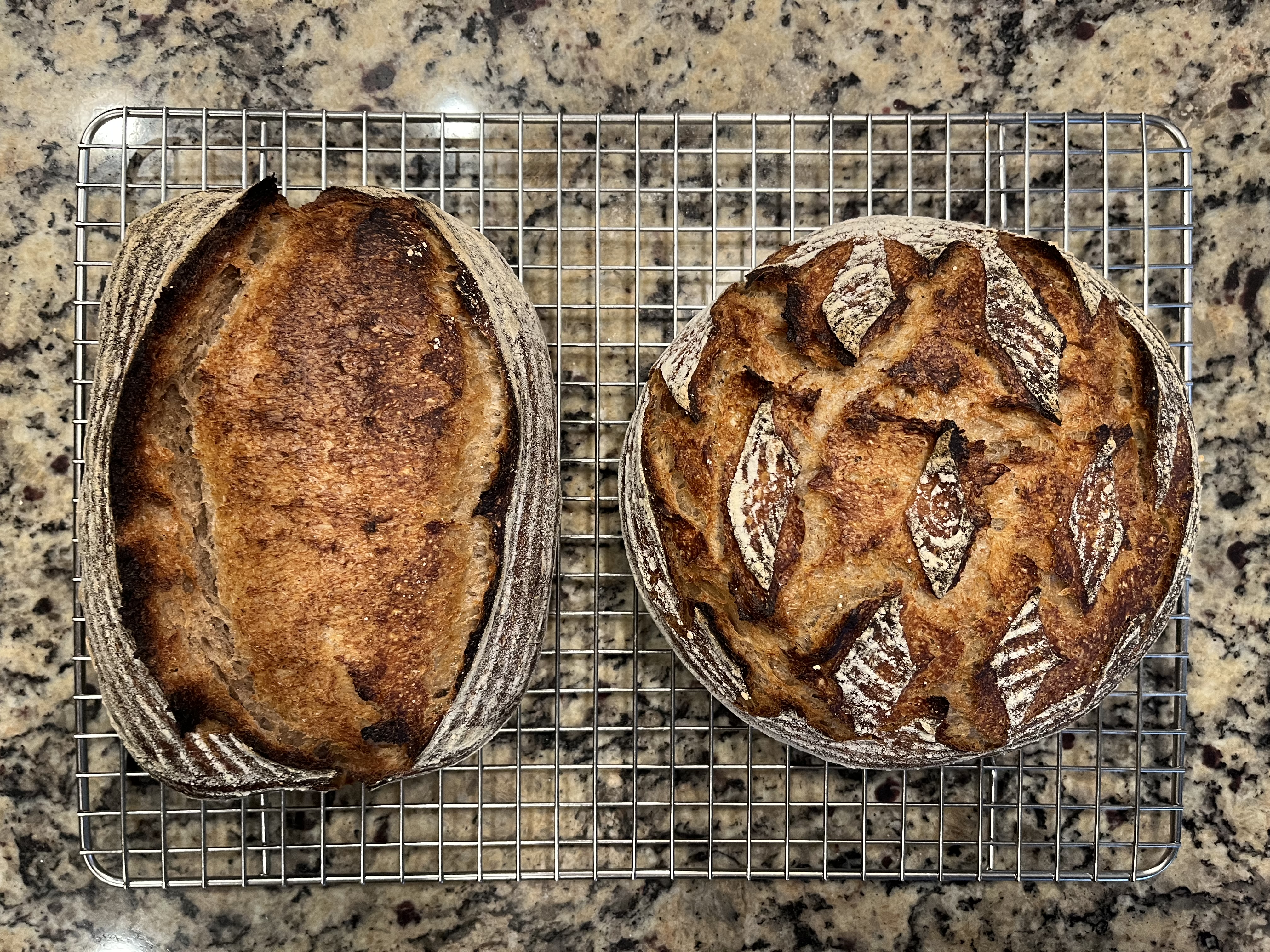 AFTER SOME ADJUSTMENTS: These loaves were finished at a lower temperature than the ones immediately above, but the browning is uneven thanks to the placement of the heating element and the effect of the circulating fan.
Putting the previous two items together, with our old oven I baked sourdough at 450° F, first for 20 minutes in preheated dutch ovens, and then for 25 minutes with the loaves directly on the center rack of the oven. Now I still start the loaves in dutch ovens at 450° F, but after turning them out I turn the temperature down to 435° F and rotate the loaves after 15 minutes.
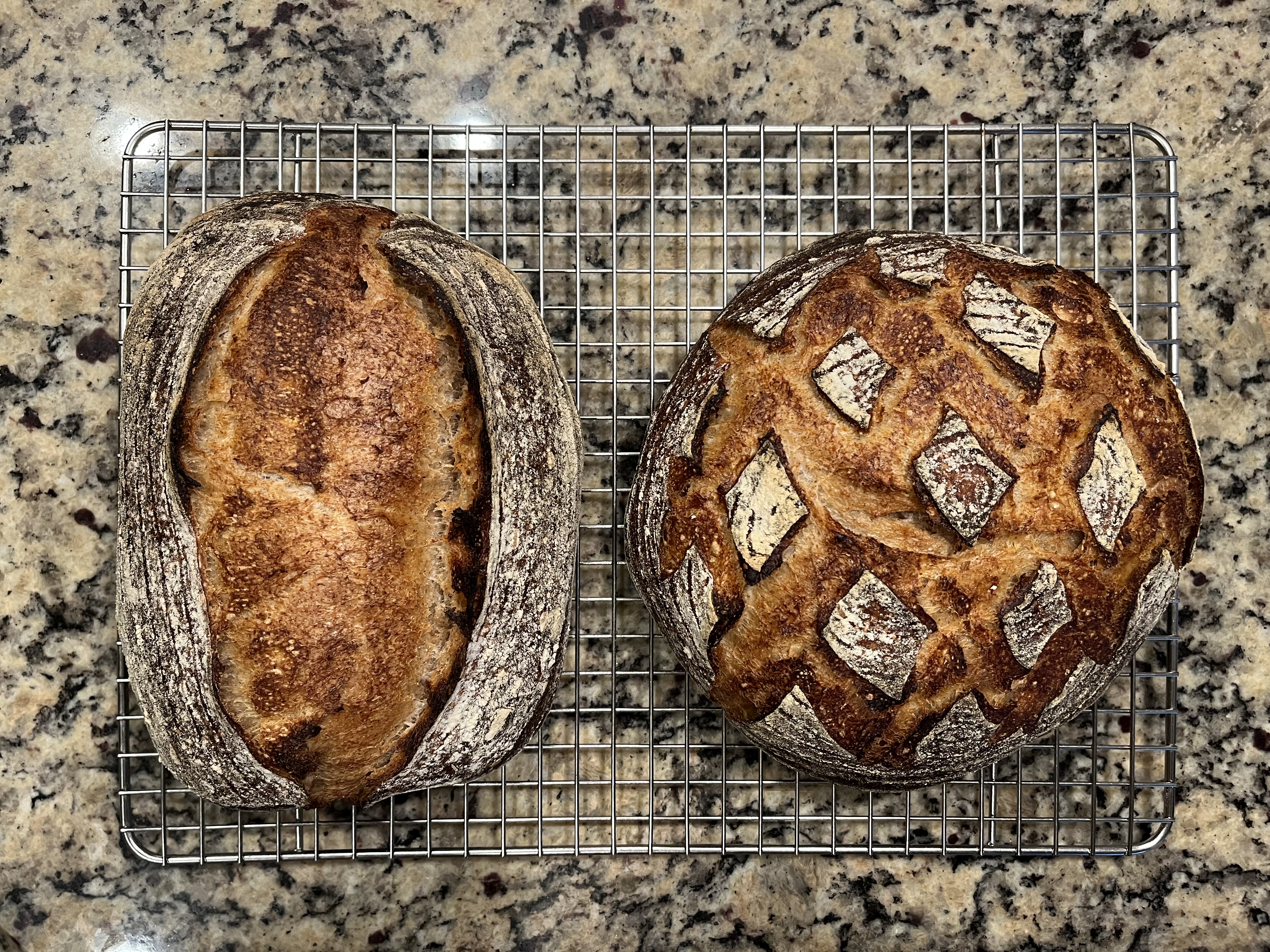 AFTER EVEN MORE ADJUSTMENTS: As described in the text, these were finished at a lower temperature than they would have been in the old oven, and they were rotated once partway through baking to assure even browning.
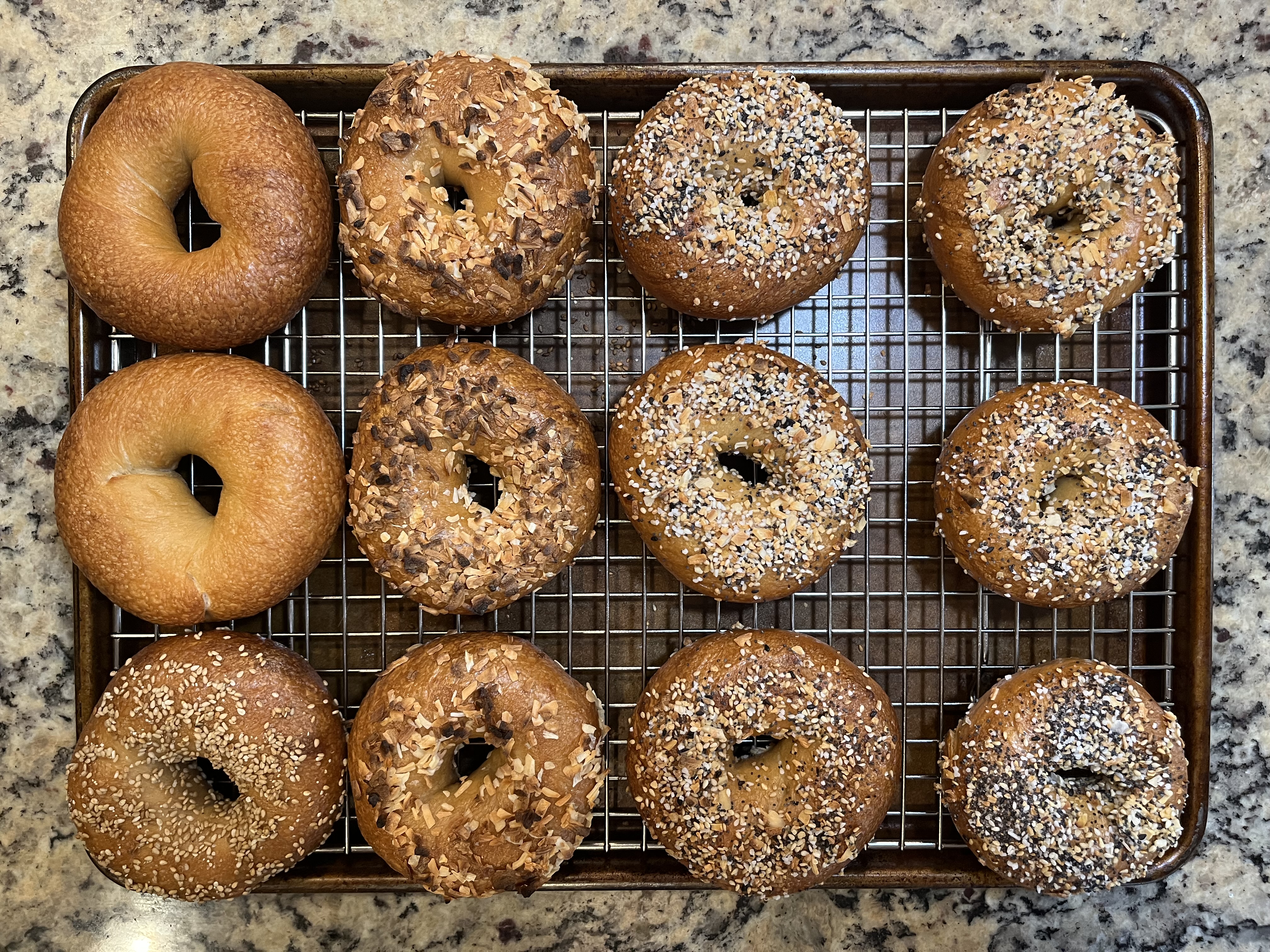 These were started on a stone in the upper oven as in the previous photo, but they were finished in the lower oven at 435° F and rotated several times so they browned evenly.
The cooktop is mostly good. The two big burners in front have higher maximum output than the two big burners on our old range and we've had a bit of a learning curve so we know what “medium heat” means on the new knobs. The front left burner has a single large ring; the front right burner is a precision style with two rings, designed in such a way that the outer ring only engages when the knob is at or above “medium.” In theory this gives you finer control of the low end, but in practice the heat output of the burner varies in two distinct, discontinuous ranges with a significant jump when the outer ring engages.
Our old range was a “freestanding” style with controls on a riser at the back, that crowded the back burners, making it difficult to use multiple large pans at once (as mentioned above). The new one is a “slide-in” style with the controls at the front, and more usable space for large pans over the back burners. I know the actual surface area is the same, but the extra flexibility without that riser in the back is nice.
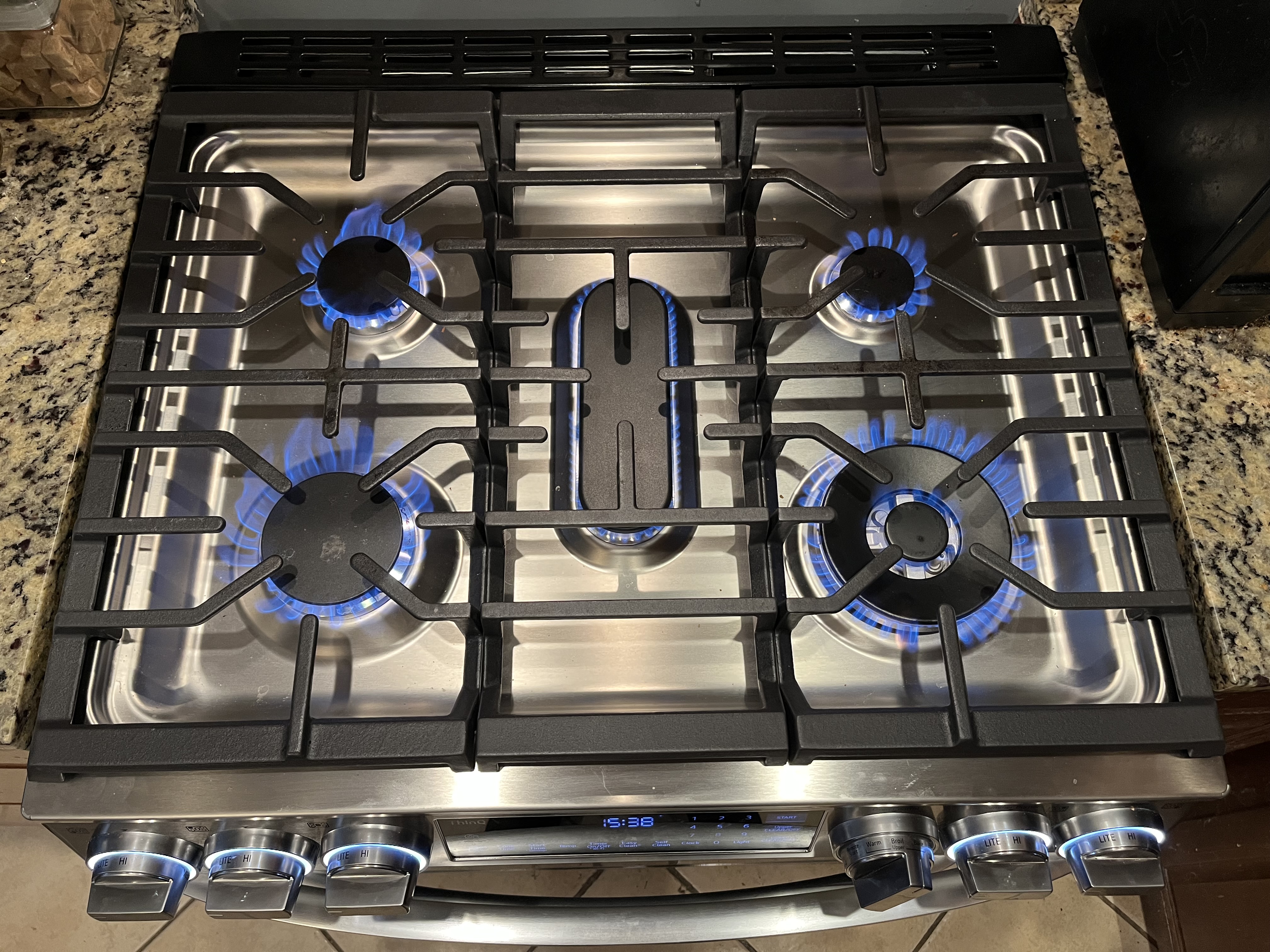 The cooktop seems less crowded than the old one because it doesn't have the riser for the control panel and oven vent at the back. Since the oven vent is flush with the grates, there's more effective space to move pots around or center them over each burner.
The fifth burner in the middle, and the griddle, are … OK. The manual tells you to preheat the griddle for five minutes, but the ends just don't get hot even after preheating. Whenever I cook on the griddle I have to move things around constantly so everything cooks evenly. This is one feature where I think the comparable Café model might be better, since it has six burners and not just five, although I suspect that in that case you could just end up with two hot spots with a cold spot in the middle, instead of two cold spots with a hot spot in the middle. Also, the LG griddle itself has a weird, rough finish. All my other (inherited) cast iron cookware dates from the days when cast iron was sandblasted or ground smooth before sale, and I'm always able to clean it simply by wiping it with a paper towel and some coarse salt. The griddle's finish is so rough that it shreds my paper towels, so I have to clean it with soap and water. And it's an awkward size to wash in our sink.
Our house is a hundred years old, our floors are uneven, and there's a gap in the tile where the gas supply line comes up through the floor. I had managed to get the thing level before the plumber came to fix the gas supply line, but one of the feet was extended so far that it fell out when we pulled the stove away so he could replace the fitting. Then another one of the feet broke as we slid the range into place after the repair. I feel like the feet could have been designed better and perhaps should be longer, or that they should at least sell a longer accessory foot to use when your house is a hundred years old and your floors are all uneven. I was able to order a replacement online, and to get the thing level again, but I wish I hadn't needed to struggle so much to do that.
Shortly after we replaced the range, the door of our microwave broke in such a way that we had to replace the whole appliance. For reasons we also ended up with an LG microwave. The two appliances can be linked so that the range light and/or fan will automatically turn on whenever the cooktop is in use, which is nice, but both appliances have the same alarm for their timers. If we're using both timers at once and one goes off, we have to be careful that we don't cancel the wrong timer. You can change the “cooking done” song on the oven, but you can't change the timer alarm on either device. This seems like a mistake.
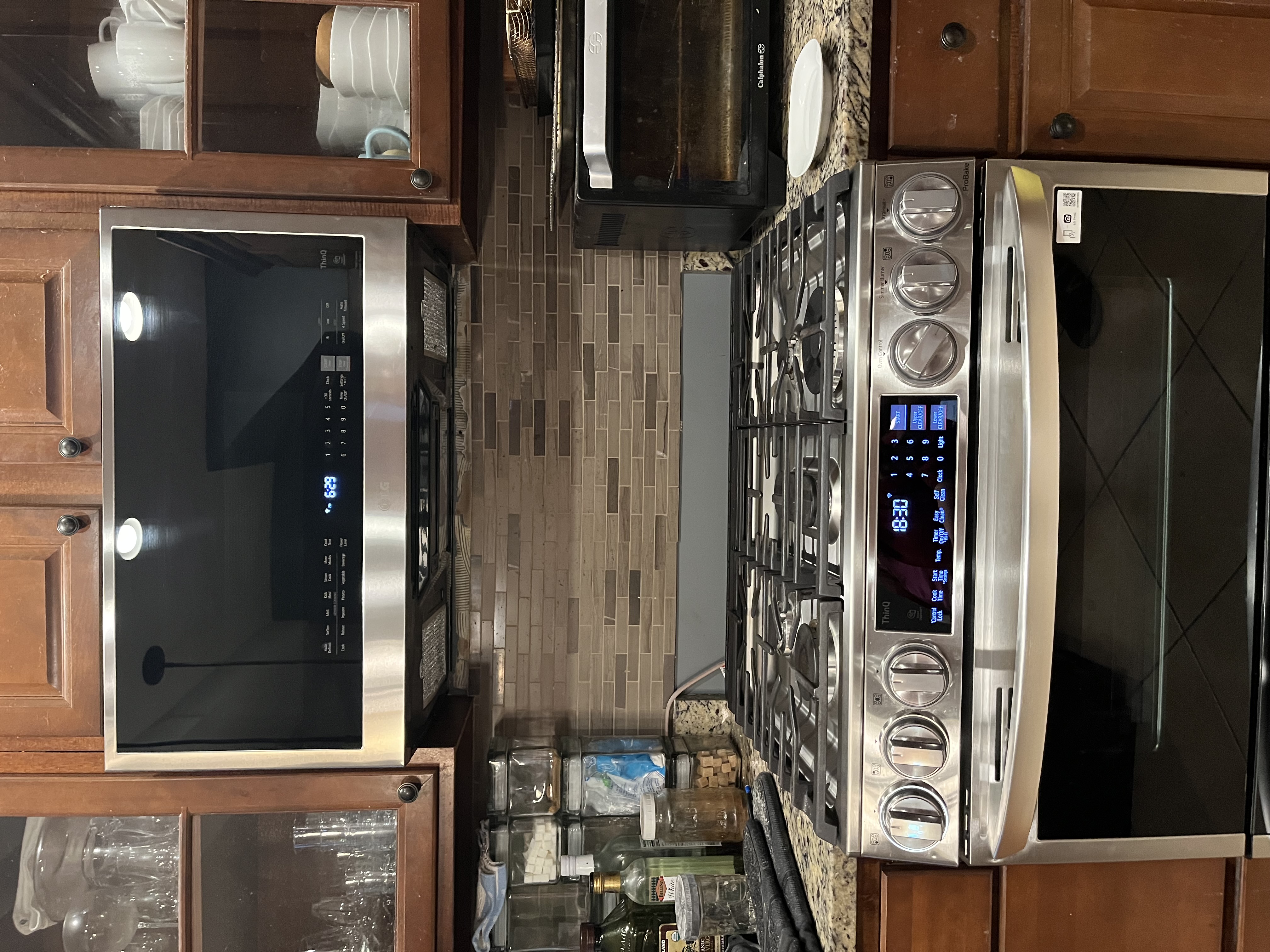 At least the new microwave has the same stainless steel finish as the range. The dishwasher and fridge are different brands with different steel, but you're usually not looking at all of them at once.
Both ovens preheat faster than the old oven did. That's not at all why I picked this model, but it's nice.
Despite the common refrain, when we required warranty service (because the cooktop spark igniter failed early on) LG was in fact easy to deal with and the repair was quick.
In the end I'm happy with it, and I'm happy with the choice to get a double oven model. Aside from bagels we've used both ovens at once several times, such as when preparing Christmas dinner, when it was useful to have two different temperature zones at the same time. We lost a little storage space but the drawer in the old range was actually kind of stupidly designed so we didn't lose as much space as you'd think. I think if we actually wanted to roast a big turkey for Thanksgiving I might have some misgivings, but I don't like turkey so we don't have that problem.
I don't have comments on here, but if you want to respond to this post, I'm on the fedi as fedward@distraction.party.