Late last fall we “suddenly” found ourselves in need of a new kitchen range. While doing research on what to buy, I discovered that several appliance manufacturers made ranges that did away with the common storage drawer under the range and used that space to squeeze two ovens under the cooktop. With the way we actually use our range, this seemed like it might be a good fit for us, but then I started to lose my mind trying to figure out if seeming like was close enough to being. Then I lost what was left of it while trying to find something to, y'know, buy, especially in time to cook Christmas dinner. But we managed it.
I've been using elementary OS on an old MacBook Pro and there's surprisingly little that I hate about it. That, of course, has given me time to find things that I don't quite like as much as I want to and then poke around and see if I can make them better. Last week's effort was some fine tuning of my keyboard layout that resulted in me filing a bug report, but it also meant that I had many opportunities to be disappointed by the system's appearance during startup.
Previously on this blog, I wrote about buying some new NAS hardware and installing TrueNAS. I expressed some mild discontent with the fact that TrueNAS is now based on Linux and not FreeBSD (like it used to be), but part of what I wanted out of a NAS was that it be an appliance I didn't have to manage as intensely as I would if I installed everything myself. Joke's on me.
Whenever people ask “what operating system do you use” my answer is usually some variant of “all of them.” Except for a brief gap in the late 90s, since my college days my primary desktop operating system has been the Mac. Since that gap in the late 90s (when I actually paid real money for a nice HP) I've generally had at least one computer around that could run some version of Windows, but it's never been my preference. And the running joke of “this could be the year of Linux on the desktop” was always just that: a joke. But I can't help feeling now that things have changed, because of a confluence of factors.
It was getting to be time to decommission an old Mac mini that we use as a DVR and media server, and so I checked prices of new Macs and bought some NAS hardware instead. At the same time I ordered four hard drives and a couple SSDs to populate all its slots; after placing the order, I did more research and realized it probably didn't include enough RAM (clearly they learned from Apple) and spent a little more money to order that, too. The hardware is great. Installing the drives, the SSDs, and the RAM was easy. But then I installed TrueNAS and things got messy.
A few years ago my wife expressed a preference for iced coffee in the summer, and then as cold brew gained enough in popularity that it started showing up on tap everywhere, she expressed a preference for that over my previous, lazy man's iced coffee method (namely: brew a pot of hot coffee, then immediately put it in mason jars with as little headroom as possible and refrigerate overnight).
I tried all the most common instructions for cold brew on the internet, and I found that no matter what I did I just wasn't satisfied with any of them. I'm not going to call out any specific guides to making cold brew concentrate, but here is what I found:
What I didn't mention in the post about port forwarding DNS requests was that the AdGuard Home instance I'm running is running on the same OPNsense firewall as my primary, non-filtered DNS resolver.
I make a lot of technical decisions based on a simple process where I learn about a thing and go, “Oh. Oh, no. Not that.” Then I have to figure out what not-that thing to use instead. Lather, rinse, repeat.
So, for example, my home firewall used to run pfSense. After their shenanigans with OPNsense.com I started to think that maybe I didn't want to be running pfSense anymore, but switching to something else would have taken time and effort so I just … never got around to it. Then, in a push for profits, pfSense owners Netgate also took a hostile stance towards users of the community edition, but my firewall still worked as it was, so I still didn't get around to changing it.
Then the FreeBSD WireGuard mess happened and I decided I needed to get away from any code managed by the people responsible. So now I run OPNsense. There's a common lineage (m0n0wall) and I was able to adapt my configuration without much trouble.
I've always liked riding bikes. When we were too young for driver's licenses, my friend Ben and I used to ride our bikes to Wendy's and try to get them to serve us at the drive-thru. In college I started riding again because it was the best way around (and, eventually, to) campus. My first year in the DC area I didn't ride much, mostly because I lived in Arlington and worked downtown. When I moved into the District I started riding again, and to this day I'm still riding the 2000 Cannondale M400 MTB I bought to commute on.
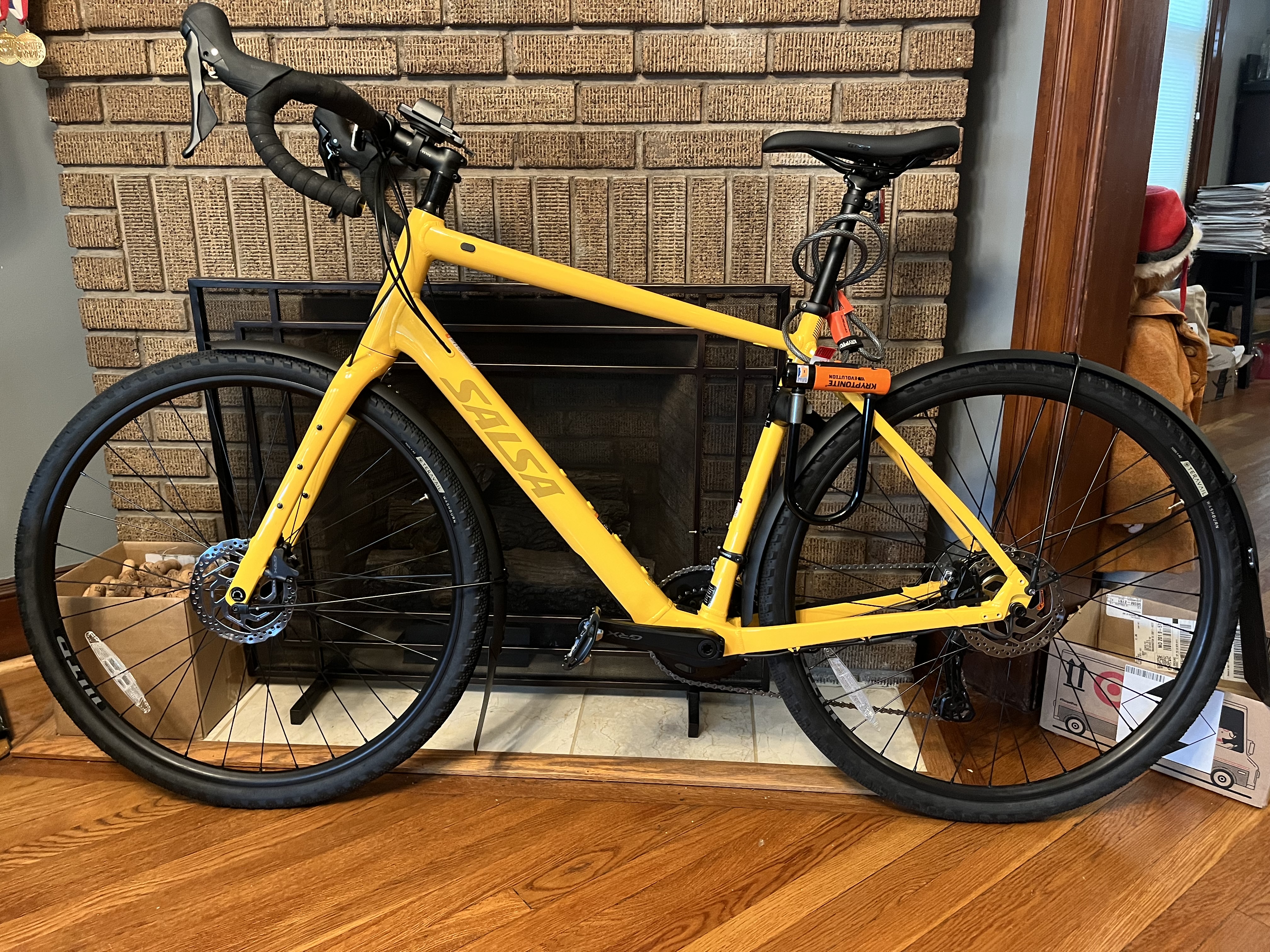 Salsa Confluence GRX 600 2x, in front of our fireplace