In which I actually have a new bike
Previously, I wrote about trying to buy a new electric gravel bike. Good news! I was successful.
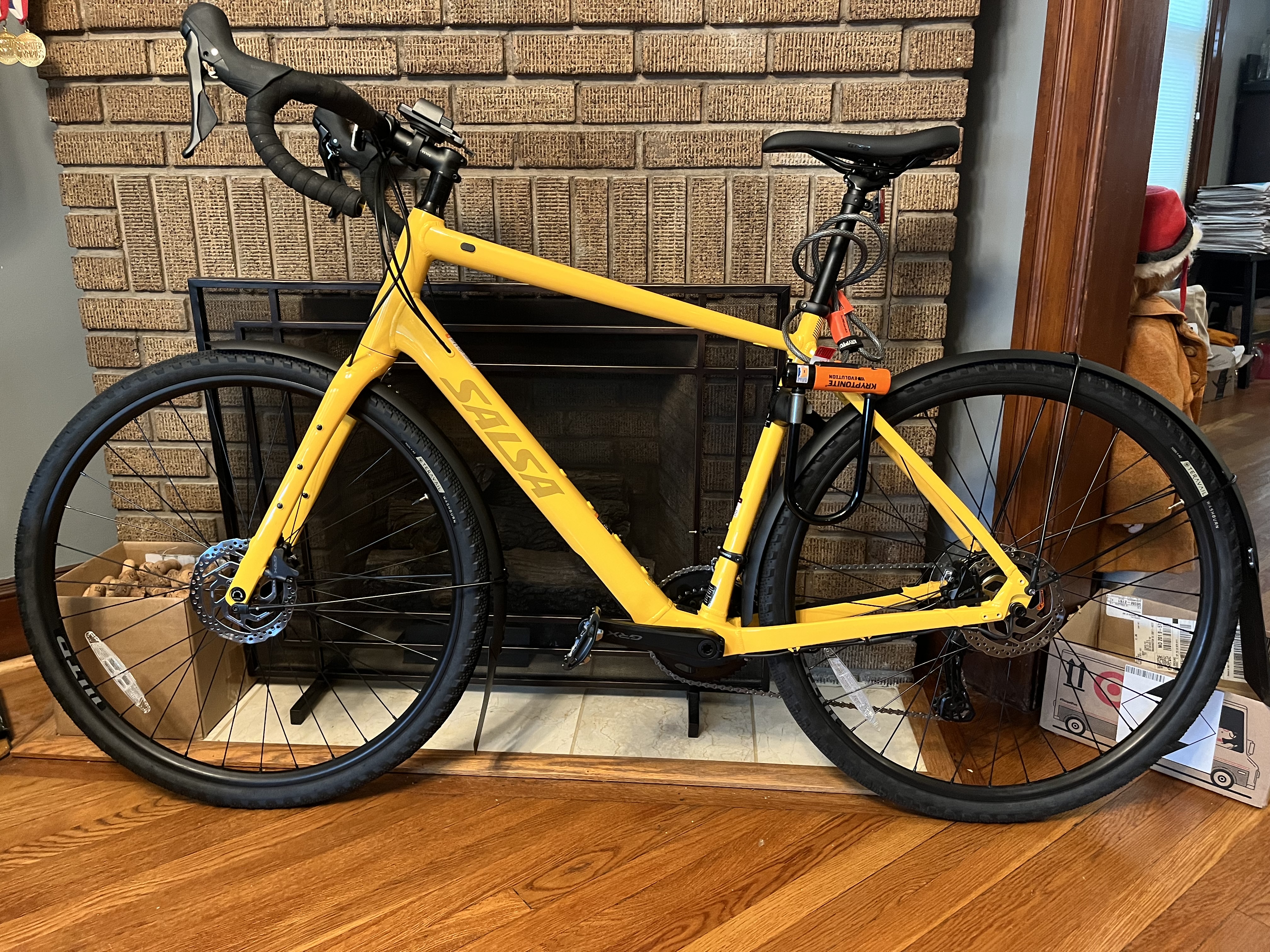 Salsa Confluence GRX 600 2x, in front of our fireplace
Here are some notes on the process and initial impressions of the bike itself.
The Buying Experience
First, I'm not sure I recommend the experience of buying a bike from REI during a big sale event. Despite being a co-op, they've been corporatized to the extent that the bike shop within the DC flagship store is only barely adequately staffed for regular business, which means they're understaffed for peak times. Before I get into anything else, I do want to say that all my interactions with the staff at the DC flagship store have been great, and I don't think it's their fault they're understaffed for the amount of business the store gets. But the fact is, they're understaffed for the amount of business the store gets, and it shows.
I suspected they'd be backlogged due to the Member Days event, so I waited a couple days after their automated system told me my bike was at the store, and then I called the store itself to speak to the bike shop about when it might be ready. (Pro tip: if you're waiting on a bike, call the store and not the 800 number.) When I called that Friday morning, they thought they might get to it that evening. In the process the person I spoke to on the phone pulled up my account and saw that I'd ordered two bikes, and he asked if there was anything different between them. I said that one of them came with extra bonus rewards from the credit card, but I was planning on canceling pickup of the other one. Shortly after that I got a notice that the first order (the one without the extra reward) had been canceled. If I'd known that would be possible I'd have had them cancel it sooner, but I've been assured it's not a problem.
As expected, I didn't get any notification that it was complete on Friday, and I assumed they'd just be slammed over the weekend so I didn't call again until the following Monday. When I did, they said it was built but hadn't been inspected, and there was nobody on the schedule who could inspect it. So it wasn't ready until Tuesday, a week after they'd received the bike.
When I picked up the bike that Tuesday, I used my free hour of setup to have fenders and pedals installed, and then I started riding home. I made it a couple miles before realizing that one of the two shift/brake lever assemblies wasn't clamped down tightly enough and would move if I happened to apply force to it (like when I stood on the pedals to cross the street at a green light). So I turned around and rode back to REI, where the same tech who'd installed my fenders again helped me. He seemed personally affronted that the loose assembly had passed inspection, so he took a little extra time to double check all the bolts (again: I have only good things to say about my interactions with the team at this REI location).
Customization
In addition to the fenders and pedals, I also ordered more accessories from REI (using member rewards), as well as lights and a wiring adapter I had to order elsewhere. Here's what I have so far:
| Item | Retailer | Price | Payment |
|---|---|---|---|
| Salsa Confluence GRX 600 2x | REI | $3499 | Card |
| Shimano PD-EH500 pedals | REI | $80 | Rewards |
| PDW Full Metal Fenders, 700×55 | REI | $139 | Rewards |
| Salsa Side Entry Water Bottle Cage | REI | $16 | Rewards |
| Knog Scout Bike Alarm & Finder | REI | $59.95 | Rewards |
| Salsa Wanderlust Rack | REI | $99 | Rewards |
| Kryptonite Mini-7 with 4' Flex Cable | REI | $97.95 | Rewards |
| MAHLE X35 light wiring adapter | Tree Fort Bikes | $28.99 | Card |
| Knog Blinder E 900 Front E-Bike Light | Knog | $60.40 | Card |
| Knog Blinder E RH Rear E-Bike Light | Knog | $34.50 | Card |
| Installation of lights and wiring | REI | $172 | Rewards |
As mentioned above, when I picked up the bike I had REI install the fenders. I installed the rear rack myself, attached the front and rear lights as appropriate, and took the bike back to REI to get the lights connected to the bike's electronic system (a process that requires removal of the pedals, bottom bracket, and battery). Unfortunately, when I installed the rear rack I found that I needed to tap the frame eyelets so the bolts would thread without galling. Since I didn't own a metric tap and die kit, that's another $30 out of pocket, but now I own those tools.
Further, the front light's 8W maximum power draw exceeds the bike's specifications. It's possible to configure the light to a total of four power levels (4W, 5W, 7W, and 8W), but while I was testing that I kept getting error messages in the bike's app. Eventually I realized that if the power draw was too high (7W or 8W), the error would pop up when the lights were turned on; but if the lights were configured to low enough power the error didn't pop up until I used the bike's controller to turn the lights off. I can replicate it, so I filed a bug report with the drive system's manufacturer. (They've responded with a theory, and we've had some emails back and forth, but this isn't resolved yet).
Bank Error in Your Favor, Collect $200
Getting paid in scrip instead of actual money isn't my favorite, but it seems like my hunch was correct that the credits (in whatever form) would pay for most of the accessories I'd be adding to the bike. The breakdown:
- $349.90 in a “single use bonus card”;
- $100 in a gift card for using the new REI Rewards credit card somewhere else within the first 60 days;
- $2.21 in rewards for using the REI Rewards credit card somewhere else, just as regular spending;
- $185.45 in rewards for using the REI Rewards card at REI;
- $185.45 in bonus rewards for doing so during the Member Match days.
That's $823.01 in various benefits, of which I've spent $693.41. I did have to pay out of pocket to get lights and the wiring for them, but the bulk of what I've “spent” has come out of various rewards. That feels OK. (I've also bought some panniers and I want to get some shoes, but neither of those feel like part of the setup since they don't get permanently attached.)
The amount above also excludes the 2024 member reward expected by March 2025. A 10% reward (“typical, but not guaranteed”) would be $399 based on just the spending totaled above. This definitely softens the blow. Your accessory needs may vary.
But Enough About That. How Does It Ride?
I'm still on the learning curve, but I'm a little surprised how closely it matches the idealized bike in my head.
I wanted something that had a comfortable default position on the hoods for getting around the city, but that gave me the option of the drops when I wanted them, and the fit seems really good for both of those. I had to get REI to raise the seat before I'd gone very far, and I ended up raising it a bit more when I got home, but the bars feel like they're in a good place. I'm still getting used to having flat pedals without toe clips. I know toe clips are well out of fashion now, but I liked not having to think about where my feet were on the pedals and whether they were likely to slip.
It strikes a really nice balance between being powerful enough to level the hills and being light enough that it feels like a normal bike and not an e-bike. It's definitely not as punishingly stiff as the new Capital Bikeshare e-bikes are, so it gamely handles DC's pitted streets. I like the fact it's possible to customize the level of assistance, but I haven't yet settled on what levels I like best. I'm currently using the commuter preset but I have to admit that its maximum level of assistance seems like more than I need most of the time. I appreciate the extra help when I'm really feeling fatigued though.
As I focused on my research before buying anything, I noticed that a common complaint about hub motors (as opposed to mid-mount motors) is that they don't have enough torque at low speed, meaning that they can't provide enough assistance when you really need it, like going up a hill. In my experience this complaint is unfounded. I don't think of myself as the fittest, most powerful rider, but I've been riding bikes for long enough, and I have an instinctive enough feel for cadence and power output, that even when I'm fatigued I'm not struggling to get up enough speed for the motor to provide enough torque. Cynically, I'd guess this complaint is coming primarily from people who have more experience reading spec sheets than riding hub-motor bikes in person. Low torque at low RPM is just not a problem. Don't believe the anti-hype.
On the other end, I've gone past the 20mph limit of the motor assistance and … it's fine? Again, maybe this is just because I had a pretty good idea of my own power output before I even chose a bike, or a function of the places I've ridden so far, but I can easily get to 19 or 20 MPH on the flat. However the thing attenuates its assistance past that point just feels like pedaling a bike to me. It doesn't weigh enough to slow me down, and if I feel like I need a more aerodynamic position that's what the drops are for. The assistance can be dialed up so it's more than just a tailwind, but it's not like I feel like I miss the extra power when and if it drops out.
Do I miss having a throttle? I do not. Do I think I need more power? Not so far!
Sadly, I'm not 100% happy with everything.
The paint is terrible, and in addition to the places I know I damaged it (like installing the rear rack), there's a chip on the bottom of the top tube that I know I didn't cause. I don't love the shade of yellow anyway and I know bikes get scarred in use, but the paint really could stand to be better.
The internal control system is acceptable but still somewhat cryptic. The controller is a single button with an LED ring. There's a paper chart included with the manuals that's supposed to tell you what all the color codes from the LED ring actually mean, and how you do various things like change the amount of assistance, but everything just feels a little less obvious than it should be. To change the power assistance: press the button quickly to make the thing listen for a command, then press the button a second time to cycle through the power levels (one level per press after the first press, which doesn't count). To turn the lights on or off: short press to make it listen, then a long press. OK, I guess. It would be so much easier with more buttons and a display that didn't require you to memorize modes.
The associated app (used for customizing power levels and tracking rides) is … meh. It can save workouts to Apple Fitness, but it only records time and not distance; it doesn't record your heart rate if you don't open the Apple Watch app first; if you start a ride from the Watch app the phone app doesn't actually reflect that. It can send rides to Strava automatically, and it seems to be a little better about sending all the available data there, but I'd prefer not to have Strava in the middle there. There's also one non-obvious place to customize whether the lights come on automatically or not, but there are two other places to change the power levels. It also seems to be a huge battery drain on my phone. I had an issue this week after locking the assistance when locking up the bike. My phone's battery was very low because of the rides I'd taken earlier that day, and I'd put it in low power mode. At the start of my ride home I unlocked the assistance so I could ride home, but it seemed that the bike didn't actually get the command (maybe because my phone was in low power mode?). I rode home wondering why the assistance wasn't helping me more.
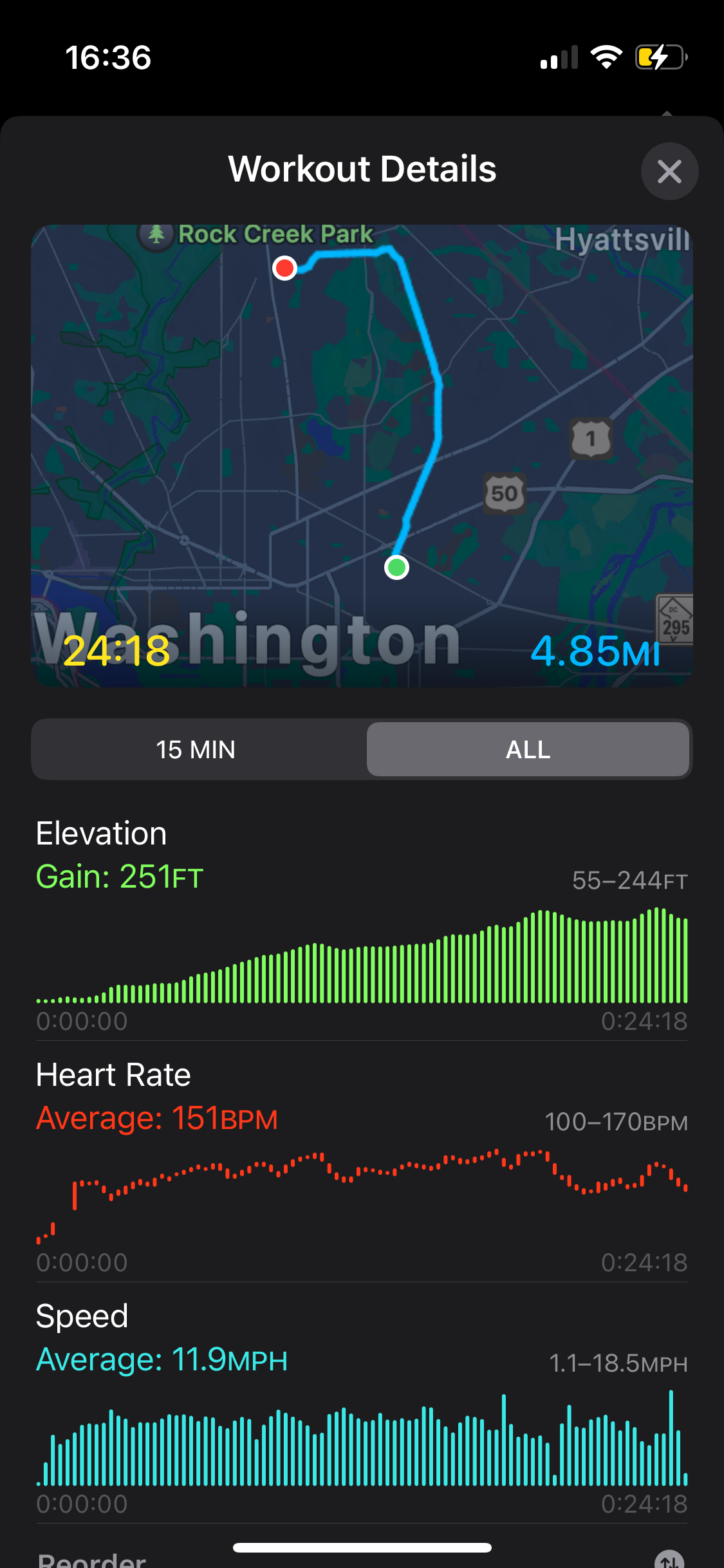 Apple Fitness cycling workout data, showing a 4.85 mile ride with a gradual climb gaining 251 feet over the length of the ride, an average heart rate of 151 BPM, and an average speed of 11.9 MPH
See? Learning curve.
Anyway, the overall experience is great. I love riding it and I feel like I made the right choice. The app could be better, but it's actually conceivable that could improve since the manufacturer does seem to care. And if I have it long enough that it needs to be repainted, well, I can pick a different color then.
I don't have comments on here, but if you want to respond to this post, I'm on the fedi as fedward@distraction.party.